

Mortgage Market Update · November 2, 2026
Rates Improved. The Payment Problem Didn't Disappear.
Mortgage rates ended October in a better place, but the payment problem did not disappear. The more useful question this week is not whether rates are finally low enough. It is what the payment needs to be for buying to make sense, and what tools may help us get there.
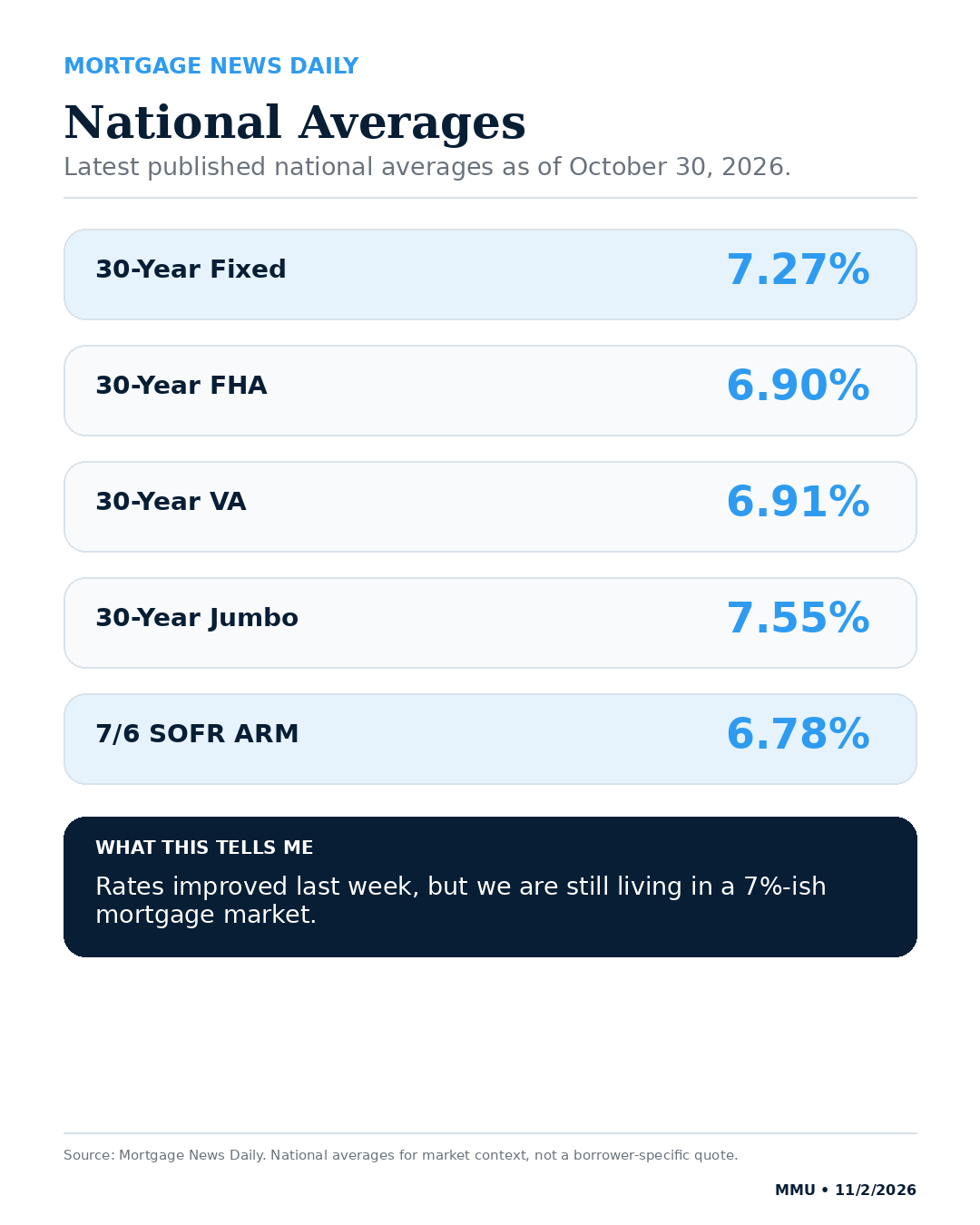
Rates improved. The payment problem did not disappear.
Mortgage rates ended October in a better place than they started it.
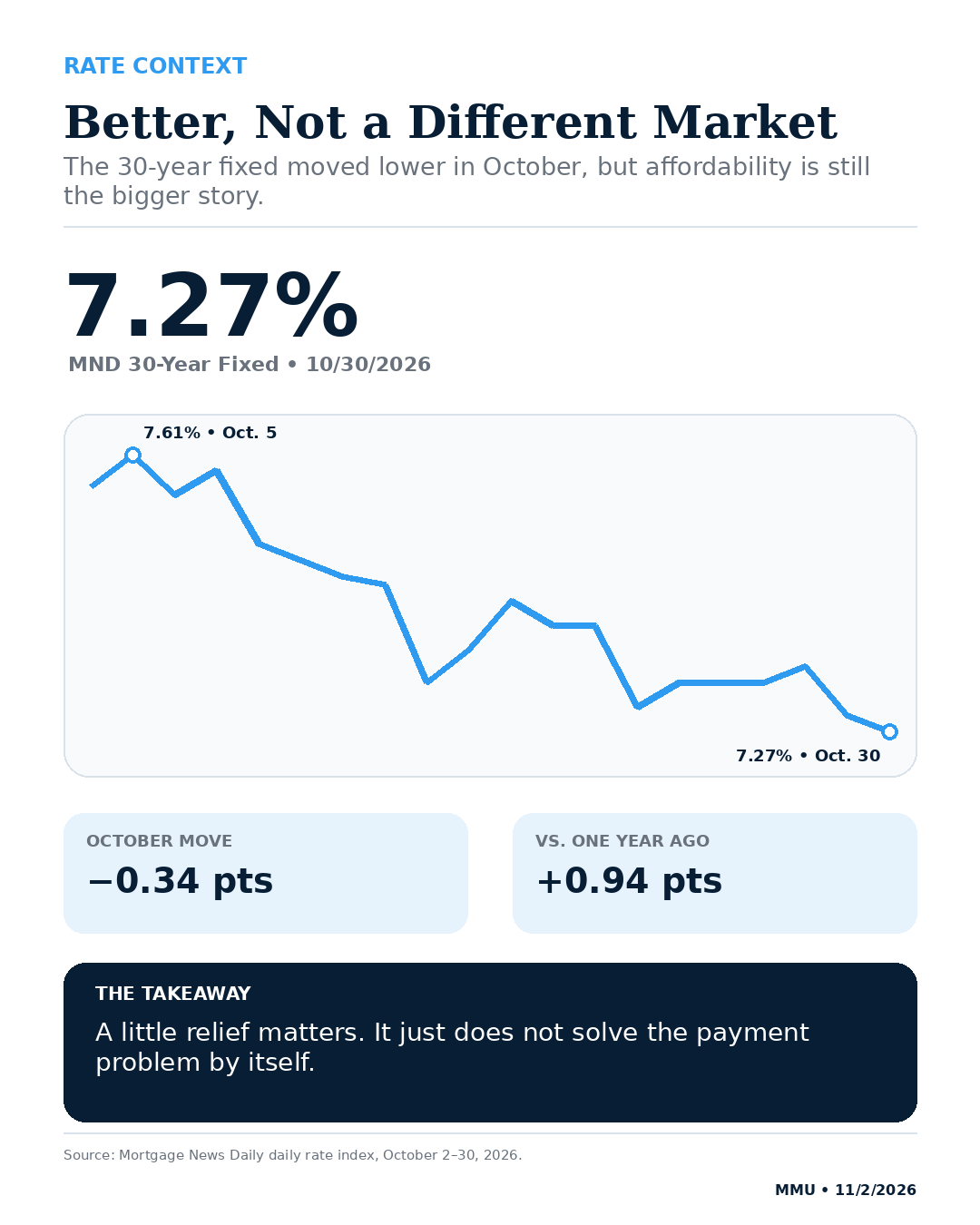
Mortgage News Daily's 30-year fixed national average finished Friday at 7.27%, down from 7.61% on October 5. FHA finished at 6.90%, VA at 6.91%, jumbo at 7.55%, and the 7/6 SOFR ARM at 6.78%.
But I do not want to oversell 7.27%.
This puts us back into the same general low-7% range that mortgage rates have returned to repeatedly since mid-September. It is relief from the worst part of October. It is not a completely different affordability environment.
The Fed was not really the story last week.
The Federal Reserve left its benchmark rate unchanged on October 28 at 3.75% to 4.00%.
Mortgage rates did not suddenly fall because the Fed held.
The more meaningful improvement came later in the week as weakness and uncertainty in technology and AI-related stocks helped push investors toward bonds. More demand for bonds can help mortgage rates.
The Fed matters, but mortgage rates follow the bond market much more directly than they follow the Fed's benchmark rate.
Buyers responded a little. They are still trying to solve the payment.
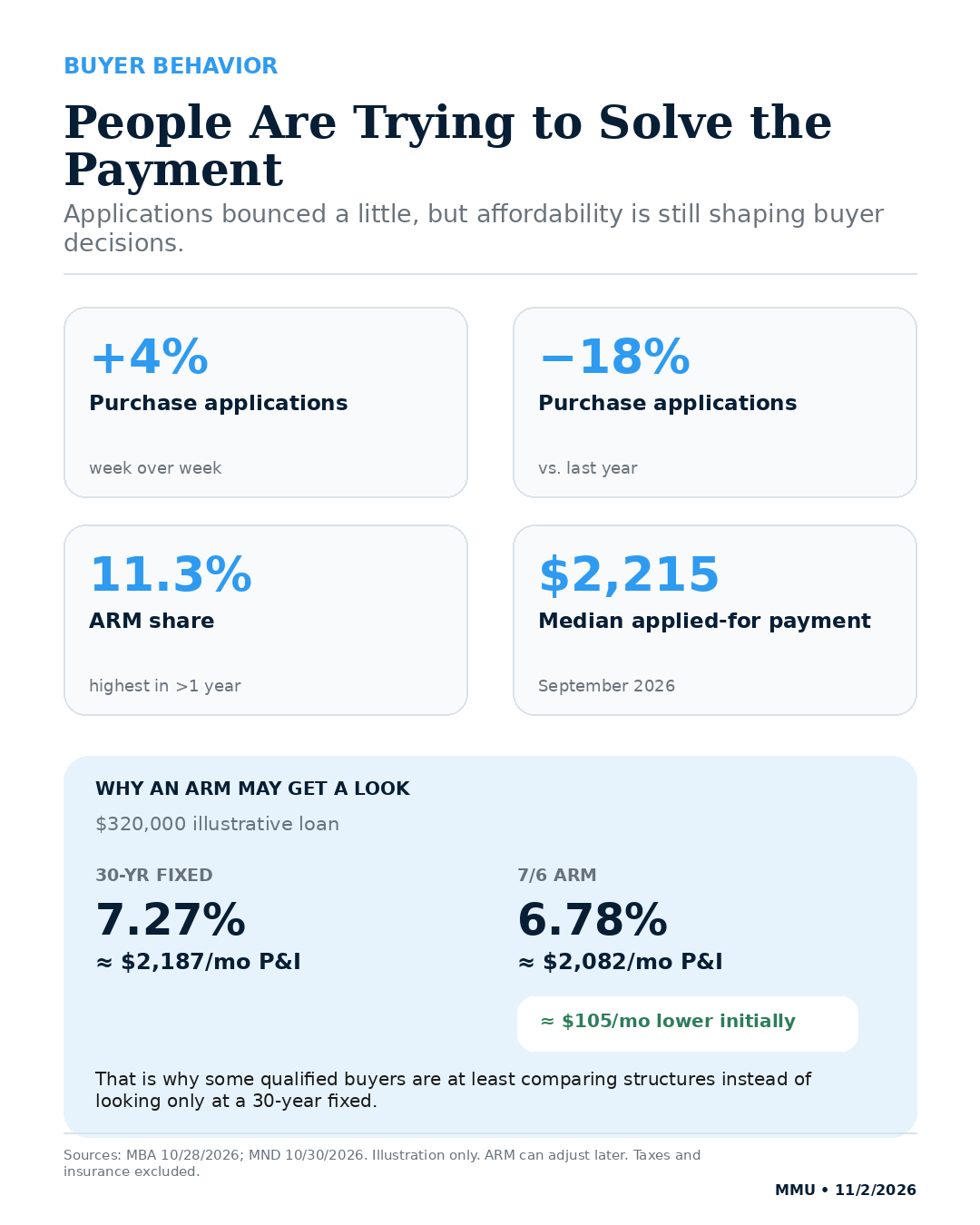
Mortgage applications increased 3.4% in the latest Mortgage Bankers Association survey, and purchase applications increased 4%.
That sounds encouraging until you zoom out.
Purchase applications are still 18% below where they were this time last year. And the ARM share of applications climbed to 11.3%, the highest level in more than a year.
We also got another affordability number last week that I think is important: the median mortgage payment applied for by purchase borrowers increased to $2,215 in September, up $53 in one month and $148 from a year earlier.
So yes, buyers noticed a little rate relief. But the real problem is still the payment.
Why an ARM is at least getting another look.
Using Mortgage News Daily's current national averages on an illustrative $320,000 loan, a 30-year fixed at 7.27% is roughly $2,187 per month in principal and interest. At 6.78%, the 7/6 ARM is roughly $2,082, about $105 less initially.
That does not mean an ARM is automatically better. An ARM can adjust later, and whether it makes sense depends on the borrower, their time horizon and their comfort with the structure.
It means we should be comparing options instead of assuming the only conversation is, "What is the 30-year fixed today?"
This is where I think buyers and agents may be leaving opportunity on the table.
Redfin found that sellers gave concessions in 44.7% of U.S. home sales in its latest national data. About 15% of buyers received both a concession and a price reduction.
Builders are negotiating too. In October, 65% of builders reported using sales incentives, and 43% cut prices.
So before I automatically ask a seller for a price reduction, I want to know what problem the buyer is actually trying to solve.
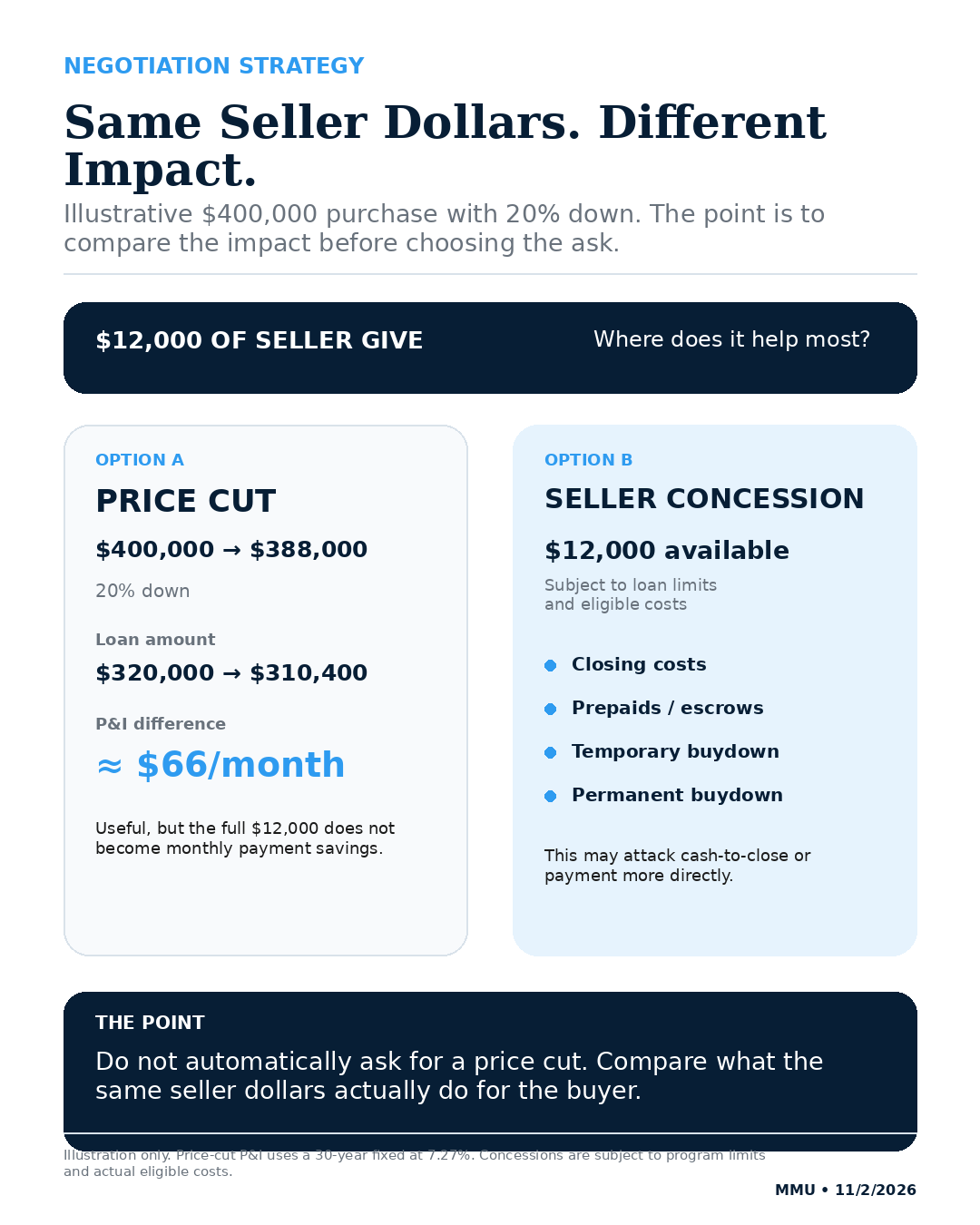
Same seller dollars. Potentially very different impact.
Take a simple illustrative example.
A $400,000 house with 20% down has a $320,000 loan amount.
If the seller agrees to a $12,000 price reduction, the price becomes $388,000. With the same 20% down, the loan drops to $310,400. At 7.27%, that saves roughly $66 per month in principal and interest.
What if instead we had $12,000 of seller concession available?
Depending on the loan program, concession limits and actual eligible costs, those dollars could potentially help with closing costs, prepaids or a temporary or permanent buydown.
I am not saying seller concessions always beat a price reduction. I am saying we should run the comparison before we decide.
If you are buying
Instead of starting with, "What rate can I get?" I would start with:
What does the payment need to be for you to feel comfortable?
Then we can work backward.
Maybe that means seller credits. Maybe a buydown. Maybe an ARM. Maybe down payment assistance. Maybe changing how much you put down. Maybe a builder incentive.
And sometimes we run everything and the answer is still, "Not yet." That is completely fine. I would rather know that because we actually looked at the options.
If you are an agent
I would go back to some of the buyers sitting in your pipeline who have told you they are "waiting for rates."
But I would change the question.
Instead of: "Are you ready to start looking again?"
Try: "What would the payment need to look like for you to feel comfortable moving forward?"
Then send me the scenario. Qualifying someone and helping them become comfortable making an offer are two different things. That is where I think a strong agent and lender partnership should actually matter.
What I am watching this week
The October jobs report is scheduled for Friday, November 6, and we also get job-openings data Tuesday. Labor-market data matters because it can change how bond traders think about economic growth, inflation and what the Fed may need to do next.
I am not trying to guess Friday's number. I am watching what the market tells us and helping buyers make decisions with the market we actually have.
Clean or complicated, I'd love to work with you.
Frequently asked questions
A few questions that usually come next
Did mortgage rates improve at the end of October 2026?
Yes. Mortgage News Daily's 30-year fixed national average ended October 30 at 7.27%, lower than early October, but affordability remains challenging.
Why are more buyers looking at ARMs?
ARM usage has increased because the initial rate can be lower than a comparable fixed rate. Whether an ARM makes sense depends on the borrower's timeline, risk tolerance and loan terms.
Is a seller concession better than a price reduction?
Not automatically. A price cut and a concession affect the buyer differently, so the better choice depends on the payment, cash-to-close need, loan program and eligible costs.
Sources checked November 2, 2026
Mortgage Minute
Get the next one in your inbox.
A quick heads-up when there’s something new to read or watch.
By subscribing, you agree to receive Mortgage Minute emails from Amber Moser at Gershman Mortgage. Unsubscribe anytime.